Umoria
The Dungeons of Moria · kill the Balrog, 50 levels down
> Enter the dungeonDate of birth1983 Moria 1.0 · Umoria 1987
CreatorsKoeneke · Wilson
LanguageC / C++ ~32,400 lines; first VMS Pascal
PlatformVAX/VMS → Unix curses
Lineage
Robert Alan Koeneke played Rogue on a PDP-11 at the University of Oklahoma and, when the new VAX had no games, wrote his own: first in VMS BASIC, then in 1983 in VMS Pascal as Moria, with Tolkien's mines as the setting. In 1987 James E. Wilson converted it to C for Unix: Umoria. Umoria is the parent of Angband, and so of most games in the lower half of the family tree; BOSS is a sibling from VMS Moria.
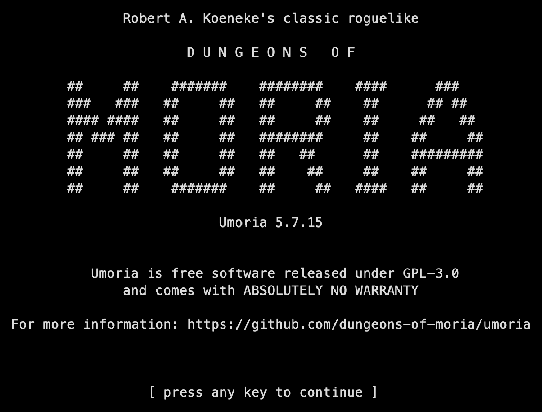
Played here: Umoria 5.7.15, the restoration by Michael R. Cook, compiled as C++.
Credits
| Robert Alan Koeneke | Creator of Moria (1981–86) |
| Jimmey Wayne Todd Jr. | Character generation, races, classes, backgrounds |
| James E. Wilson | Creator of Umoria (1987–94) |
| David J. Grabiner | Umoria maintainer |
| Michael R. Cook | Umoria 5.7 restoration (Windows, macOS, refactoring) |
Screenshots
Trivia
- Koeneke vowed Moria was unbeatable; a week later a friend won. His character Iggy went into the game as Evil Iggy, and the trick was fixed. (Koeneke, history.md)
- For the copy sent to the University of Texas before a football game, the town beggar became “An OU football fan” who multiplied at full speed. Texas had to call for a fix. (Koeneke, history.md)
- Koeneke got letters from behind the iron curtain from players on VAXes that export laws said could not be there. (Koeneke, history.md)
- The name Umoria came from the comp.sources.games moderator, who shortened “UNIX Moria”. (Wilson, history.md)
- The hardest part of the Pascal-to-C conversion: off-by-one errors, because Pascal arrays start at 1. It took Wilson years. (Wilson, history.md)
- Wilson almost decompiled UltraRogue instead, to fix its bugs, before he found the Moria sources. (Wilson, history.md)
- Diablo’s credits name Umoria as an inspiration. (Wilson, history.md; Wikipedia)
What's unique
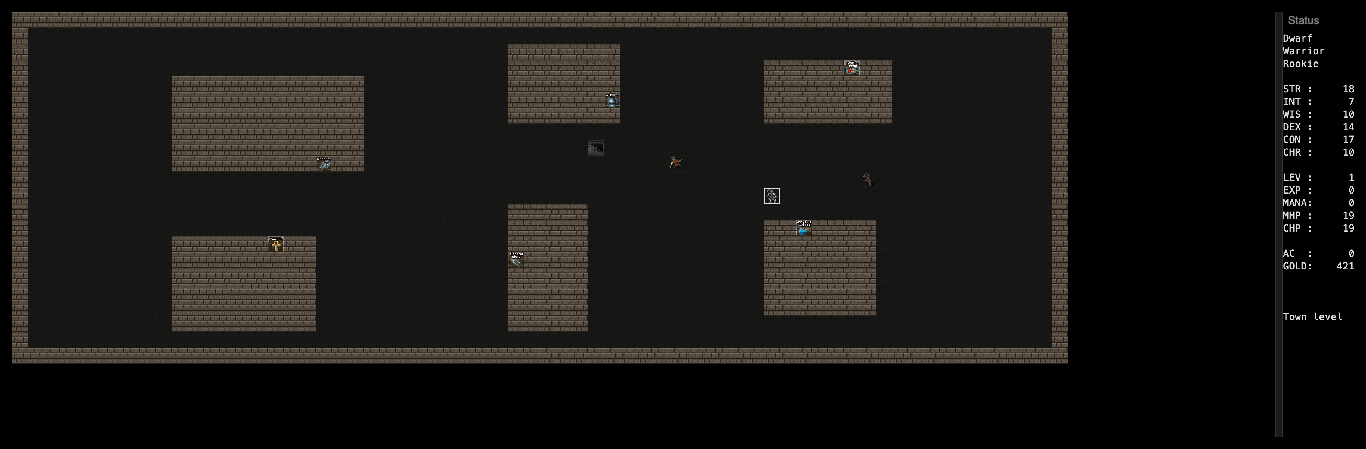
- A town with shops you return to: sell loot, buy potions and scrolls.
- Races and classes with a generated family background.
- Levels are forgotten: every staircase makes a new level, so you can dive or stay as you like.
- One goal: kill the Balrog at 2,500 feet (level 50). No amulet to carry home.
- Monster memory: the game remembers what you have learned about each monster, across characters.
Code dive
- Moria: VMS Pascal with some VAX assembler, on a VAX-11/780 at the University of Oklahoma.
- Umoria: C, for Unix and curses; later MS-DOS, Atari ST, Amiga, Mac. 5.7 is C++ with the same data tables (
data_creatures.cpp,data_treasure.cpp). - Wilson did most of the Pascal-to-C syntax conversion with Emacs macros.
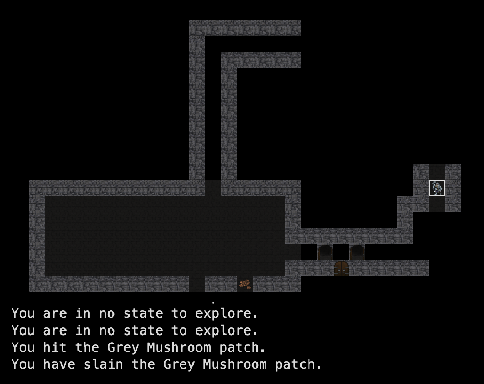
- This port: curses shim with tiles, WebAssembly, auto-explore on g. Source: memmaker/umoria, upstream dungeons-of-moria/umoria.
Stats
| Thing | Count | Notable ones |
|---|---|---|
| Races | 8 | Human, half-elf, elf, halfling, gnome, dwarf, half-orc, half-troll. |
| Classes | 6 | Warrior, mage, priest, rogue, ranger, paladin. |
| Monsters | 279 | From the Filthy Street Urchin and the Blubbering Idiot in town to the Vorpal Bunny, the Quylthulg, Creeping Gold Coins, Evil Iggy and the Balrog. |
| Spells | 31 + 31 | Mage spells and priest prayers; rangers and paladins use them too. |
| Objects | 420 | Including the shop stock. |
| Shops | 6 | General store, armoury, weaponsmith, temple, alchemist, magic shop. |
| Levels | 50 | Town, then 50 feet per level down to the Balrog. |
Manual
“The Dungeons of Moria”, the full Umoria manual from the source: read it here (Markdown text).
Getting started
- Open the game: choose race, sex and class, Escape to accept the stats, then a name.
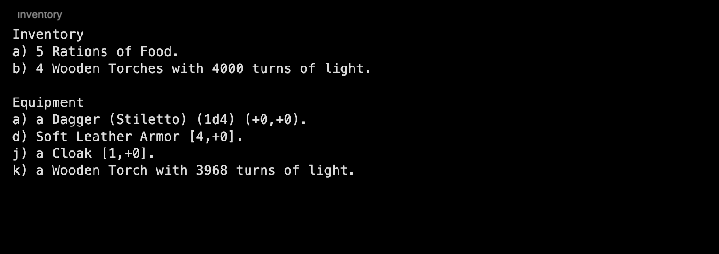
- Wear your gear: w and a letter (armour, cloak, weapon; a torch as light).
- Movement is on the digit keys 1–9 (the original keyset), or the arrows. Walk into a shop number to trade.
- Find the
>in town and press >. g explores on its own. - ? lists commands; the in-game guide has them all.
Help
No walkthrough exists. The manual’s advice, plus the usual:
- Buy Flasks of oil in the general store and throw them (v): 2d6 fire damage each, the strongest early attack for any class.
- Read Scrolls of Word of Recall to go back to town and return to your deepest level.
- Get free action, see invisible and resistances before 1,000 feet.
- More: the Moria FAQ in the source.
Cheats
- Wizard mode: Ctrl+W, answer yes. No password. The game is no longer scored. Then Ctrl+A cures everything, Ctrl+D jumps to any depth, Ctrl+F kills every monster in sight, Ctrl+L lights up the map, + gives experience. On Windows and Linux the browser may close the tab on Ctrl+W.
- Save scumming: Export save / Import save.