Hack
Rogue with a dog and a shopkeeper · the game NetHack grew from
> Enter the dungeonLineage
Hack is new code inspired by Rogue. Jay Fenlason wrote it in 1982 at Lincoln-Sudbury Regional High School with Kenny Woodland, Mike Thome and Jonathan Payne; his READ_ME calls it “an implementation of Rogue” with 52+ instead of 26 monster types. He learned Rogue at the SFSU Logo Workshop.
Andries Brouwer took it over at the Mathematisch Centrum in Amsterdam and rewrote almost all of it; by his own note the result was “more than thrice as large”, with the dog, the long worms and the shops. His versions went out on Usenet from 1984; 1.0.3 (July 1985) was the last, and the one BSD Unix shipped. Don Kneller ported it to MS-DOS (PC Hack), and NetHack (1987) grew out of Hack. This page's game is restoHack, a restoration of 1.0.3 for modern compilers. See the family tree.
Credits
| Jay Fenlason | Original author (1982) |
| Kenny Woodland, Mike Thome, Jon Payne | Helped Fenlason: the original buzz(), the chameleon, the lock file and the screen code |
| Andries Brouwer | Rewrote and extended it into Hack 1.0–1.0.3 (1984–85), Stichting Mathematisch Centrum |
| Don Kneller | MS-DOS port (PC Hack), a sibling of this version |
| Critlist | restoHack, the restoration this port is built from (Critlist/restoHack @ 0bd798b) |
| DragonDePlatino, DawnBringer | DawnLike tiles (CC-BY 4.0); the NetHack 3.6 tiles are the alternative |
Screenshots
Trivia
- Fenlason wrote it with three friends while they were students at Lincoln-Sudbury Regional High School. (Wikipedia)
- His READ_ME calls it “my first semester programming project” and gives his home phone number, adding that he has a modem and a teen-age sister. (Original_READ_ME)
- Brouwer's READ_ME points players who want “a real cave instead of dull rectangles” to his other game, Quest. (READ_ME)
- 1.0.3 went out on 23 July 1985 as a patch against 1.0.2, and it is the first version with a wizard (debug) mode. (NetHackWiki)
- It has exactly one artifact: Orcrist, a two-handed sword that does extra damage to orcs. (NetHackWiki)
- Hack still ships with many Unix systems (Debian, Ubuntu, the BSDs, Fedora), and there is even a Game Boy Advance port. (Wikipedia)
What's unique
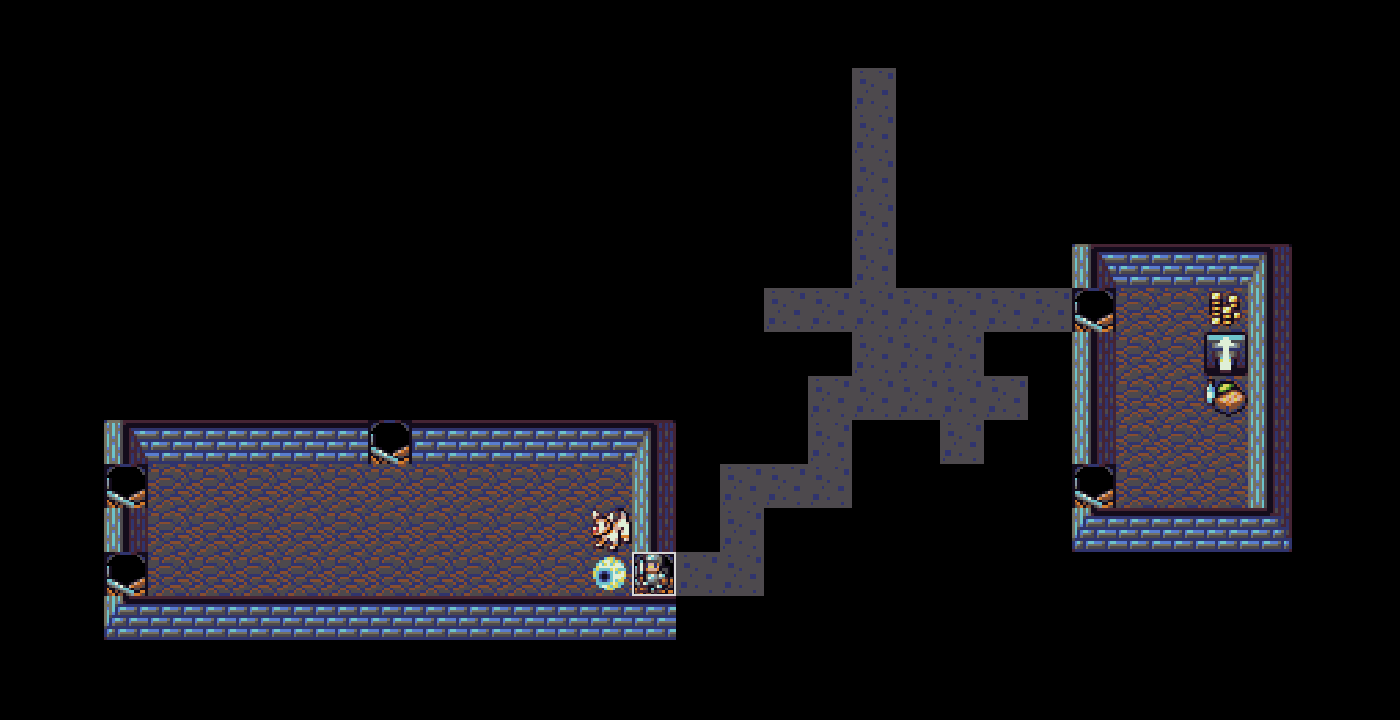
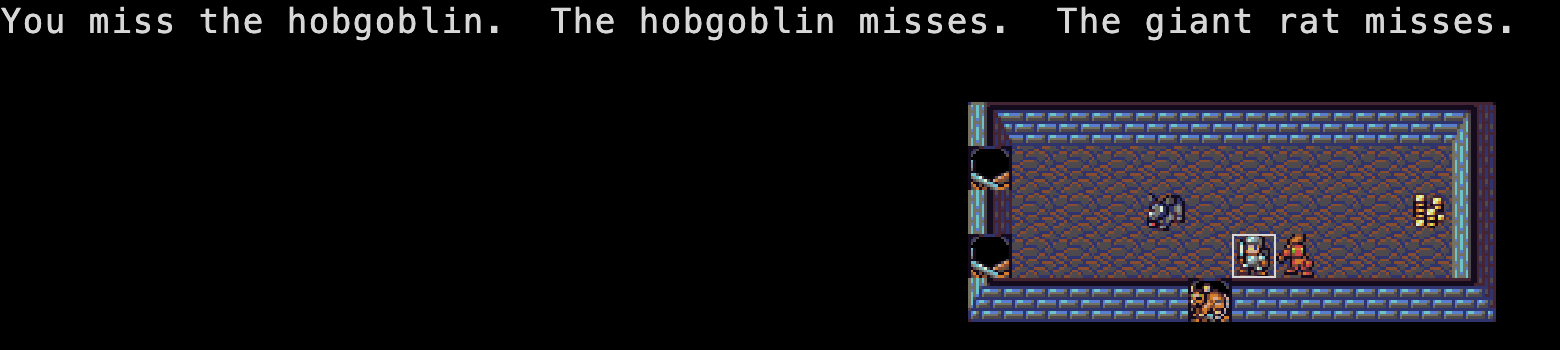
- A pet. You start with a little dog that fights for you, can be fed and trained, and won't step on cursed items.
- Shops and shopkeepers. Pick up an item, pay for it, or be chased down for stealing it.
- Things react to each other. Cockatrices stone you slowly, a dead lizard cures it; nymphs steal and teleport away; rust monsters rust your armour; floating eyes freeze you if you hit them.
- Levels are kept. Unlike Rogue, a level you leave is stored in a file and is waiting for you when you come back, with what you dropped. Bones files let you find the ghost of an earlier player.
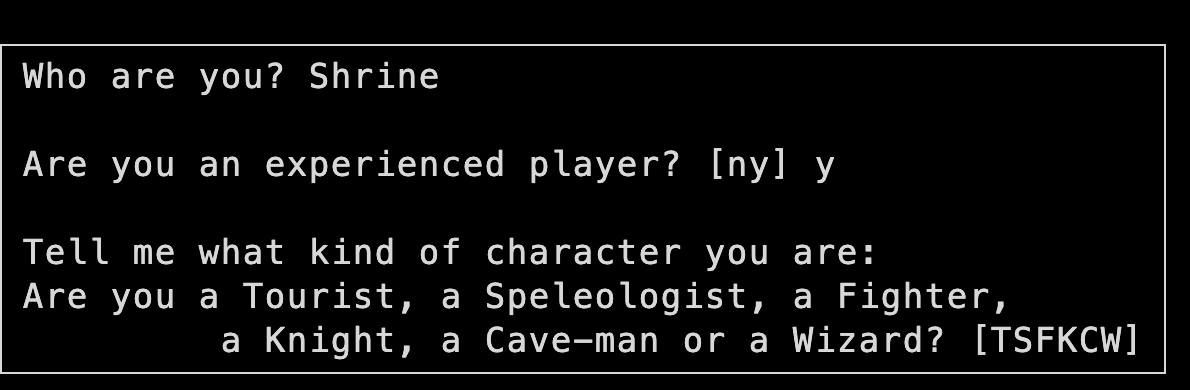
- Six kinds of hero instead of Rogue's one: Tourist, Speleologist, Fighter, Knight, Cave-man (or Cave-woman), Wizard.
Code dive
- Language: K&R C, about 19,200 lines in 77 files in the 1.0.3 source (restoHack: about 23,300 lines in 79 files after the modernisation). Files are named by topic:
hack.shk.cis the shopkeeper,hack.dog.cthe pet,hack.worm.cthe long worm. - Environment: 4.xBSD and System V Unix, played on terminals through
termcapescape codes, not curses. The data tables:def.objects.hlists every item,hack.monst.cevery monster. - Saving: the game writes the current level and every visited level to files, then exits. restoHack added a versioned save header so pointers are not written raw.
- This port: the game is not changed for the screen. Its escape codes run through a small VT100 emulator that fills an 80×24 buffer, and the map part of that buffer is drawn as tiles, in X11 and in the browser (WebAssembly via Emscripten). We fixed two bugs on the way: item labels changed after a restore, and item names showed as “<corrupted>” in WebAssembly. Source: memmaker/hack.
Stats
| Thing | Count | Notable ones |
|---|---|---|
| Classes | 6 | The Tourist carries an expensive camera; the Speleologist starts with a pick-axe and digs. |
| Monsters | 57 | The cockatrice, the leprechaun, the nymph, the long worm (grows a tail), the xan, the zruty, the nurse, the shopkeeper and the wizard of Yendor guarding the Amulet. |
| Potions | 16 | Booze, fruit juice, sickness, gain level, levitation. |
| Scrolls | 21 | Genocide, punishment (a ball and chain), amnesia, and a mail scroll. |
| Rings | 19 | Teleport control, conflict, protection from shape changers, hunger, aggravate monster. |
| Wands | 18 | Wishing, digging, polymorph, undead turning, death. |
| Weapons | 18 | Crysknife, worm tooth, boomerang; a two-handed sword named Orcrist is the one artifact. |
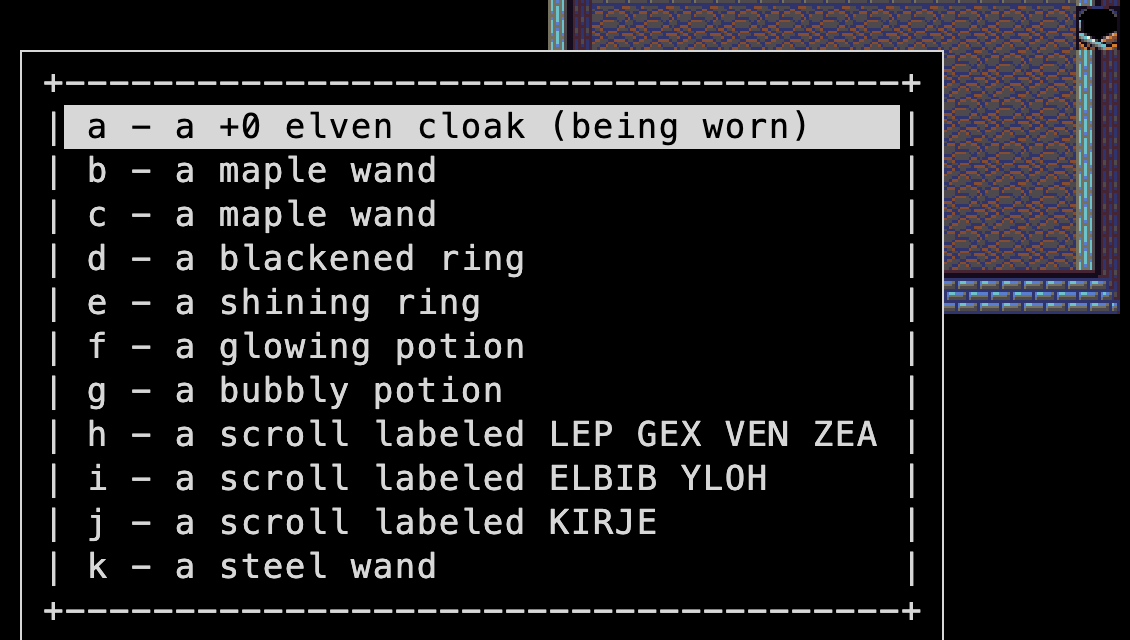
| Armour | 12 | From leather armour to plate mail, plus elven cloak, helmet, shield, pair of gloves. |
| Traps | 8 | Bear trap, arrow, dart, trapdoor, teleport, pit, sleeping gas, piercer; plus mimics posing as items. |
| Levels | 40 | Mazes from about level 26; the Amulet of Yendor is in a maze on level 30 or deeper. |
| Spells | 0 | Magic lives only in items. |
Manual
The manual page shipped with the source, hack(6) (text), and the in-game introduction, help (text). Both © Stichting Mathematisch Centrum, 1985, under its BSD-style licence.
Getting started
- Open the game, type a name and answer y to “experienced player?” to pick a class (Knight or Cave-man is easiest), or n to get a random one.
- Move with hjklyubn or the arrow keys; walk into a monster to attack. x explores on its own.
- Press Enter for a menu of every command, i for the inventory.
- Stuck in a dead end? Search with s (or 20s). Press > to walk to the down stairs and take them.
- Eat when you are “Hungry”. The full key list is in the in-game guide.
Help
We found no walkthrough: every dungeon is different. Rules of thumb:
- Never hit a floating eye in melee. Never eat a cockatrice corpse; keep a dead lizard.
- Keep the dog close on the first levels, and let it walk over shop goods and items: it won't step on cursed ones.
- Fight in corridors, rest back to full hit points before going down.
- Read unknown scrolls when nothing is near; one of them may be enchant armour.
- More: NetHackWiki on Hack 1.0.3 and RogueBasin.
Cheats
- Wizard mode (
hack -D, for the user named inconfig.h) exists in the source but can't be reached in the browser: the page doesn't pass-D. - Save scumming works in the browser: Export save before something risky, Import save if it goes wrong.